Home / Learn / How to read a tarot spread
Guide 04
How to read a tarot spread
A tarot spread is a layout with a job for every card: each position asks its own question, and the card that falls there answers it. The same card reads differently under "what's behind you" than under "what's ahead." Once that clicks, a bigger spread is just more positions.
Start with one card
The smallest spread is one card against one open question, and it stays useful long after you stop feeling like a beginner. As a daily practice it's also the habit that keeps a deck familiar. If you've never read at all, the tarot for beginners guide walks through that very first draw.
The three-card spread
Three cards in a row is the workhorse layout. Deal left to right, and give each position a job before you shuffle. Past, present, future is the classic set, but the positions are yours to assign: situation, obstacle, advice — or mind, body, spirit.
Two rules make it work. Decide the positions before you deal, because assigning them afterward turns the spread into a mirror for whatever you hoped to see. And read the row together before you read any card alone.
A worked example
Say the question is "what should I know about my job search," read as past, present, future.
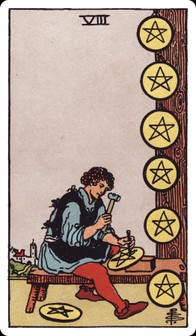
In the past position, the Eight of Pentacles: a craftsman at his bench, working the same design into coin after coin. The effort you've put in is real, and the skills are banked.
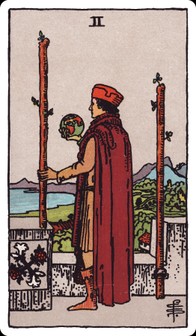
In the present, the Two of Wands: a man on a battlement holding a small globe, the sea open in front of him. Options are open and none has been chosen; the card describes the pause before a direction gets picked.
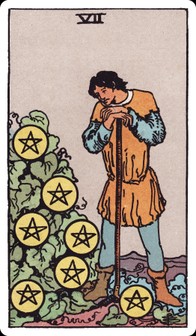
In the future, the Seven of Pentacles: a worker leaning on his hoe, watching the vines and waiting on the harvest. Expect the near term to need patience and an honest look at what the effort is yielding.
String them together: you've put in the work, you haven't picked a direction yet, and results will take longer than you'd like. Most of that came from describing the pictures and letting the positions frame them.
Decide the positions before you deal.
Reading the cards together
Once you've read each card on its own, look across the row. A suit that repeats is emphasis: three Cups in a spread, and the matter is emotional, however the question was phrased. Repeated numbers do the same thing. And count the Major Arcana, because a table crowded with majors deserves a slower read — the major vs minor arcana guide covers what that weight means.
About the Celtic Cross
The Celtic Cross covers the situation, what crosses it, its roots and recent past, what you're aiming at and what's likely next, how you and others see it, your hopes and fears, and an outcome card. It works best once three-card readings feel easy; ten positions is a lot of booklet lookups otherwise. When you're ready for it, the study order gets you there.
Two questions that come up
Do reversals apply in spreads? They apply in spreads the same way they do anywhere. Skip them until you can read the whole deck upright without checking; you lose nothing by leaving them out at first.
How often should you run a big spread? As often as you have a real question. Re-asking the same question every night just feeds the worry. Give it a few days before you ask again.
Spreads come last for a reason
Little Grimoire teaches spreads in its final chapter. By then you've studied every card that can turn up in one. One purchase, no subscription, works offline.
First two lessons free · No subscription · iPhone and Android