Home / Learn / Lenormand vs Tarot
Lenormand
Lenormand vs Tarot
Tarot works with 78 cards that each open onto a painted scene. Lenormand works with 36 that each name one plain thing: a ring, a letter, a dog, a house. The decks get shelved together, and the differences decide which one suits the question in front of you.
Where Lenormand comes from
The deck now sold as Lenormand began as a parlour game. In 1799, a Nuremberg businessman named Johann Kaspar Hechtel published Das Spiel der Hoffnung — the Game of Hope — a race game played across 36 illustrated cards laid out in a grid. Players moved a token from card to card: landing on the Cross set you back, and reaching the Anchor won the game. The booklet mentioned, almost in passing, that the same cards could also be used to tell fortunes.
The name arrived later, and from somewhere else entirely. Marie Anne Lenormand was the most famous card reader in Paris, consulted (so the stories go) by Empress Joséphine, and she died in 1843 without publishing her method. Publishers wanted her name on a product, Hechtel's little game was at hand, and within a few years the 36 cards were selling as the Petit Lenormand. She never touched them.
A smaller deck with plainer words
Pick up a tarot card and you get a scene. The Moon alone holds a dog, a wolf, a crayfish, two towers, and a winding path, and part of reading tarot is choosing which of those threads to pull.
A Lenormand card hands you a noun. The Dog is a friend. The House is home and family. The Fish are money. The Mountain is an obstacle. Antique decks spell the keyword in a banner right on the card, because there was never a secret to protect: the meanings are short, concrete, and close to universal from one reader to the next.
That plainness is the point. A tarot reader who finds a new meaning in a card every reading is doing it right. A Lenormand reader who does the same has skipped the vocabulary lesson.
Cards that combine like words
A single Lenormand card behaves like a single word: it says little until something sits next to it. Readers rarely draw one card and stop. The grammar is simple: the first card names the subject, and the cards that follow modify it. The Dog beside the Snake is a friend who deceives. The Letter beside the Fish is paperwork about money, an invoice or a bank statement. The House beside the Mice is a home with something gnawing at it, quietly getting worse.
String three together and you have a sentence.
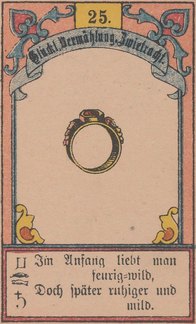
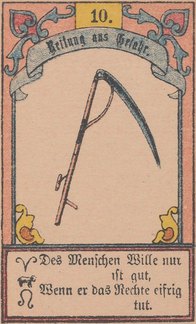
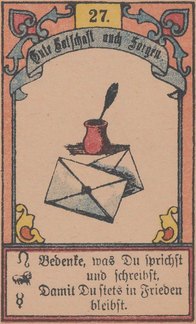
Tarot distributes meaning differently. In a spread, each card answers the question its position asks, and a strong card can carry a reading on its own. In Lenormand the position matters less and the neighbors matter more.
The meaning lives between the cards.
Same name, different card
Both decks contain a Tower, a Star, a Moon, and a Sun, and the shared names are a trap: each system assigned its meanings independently, so nothing transfers.
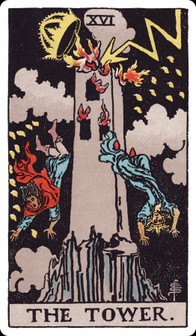
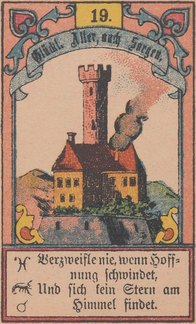
Tarot's Tower is sudden collapse: lightning, falling figures, the structure you trusted giving way. Lenormand's Tower is an institution: a government office, a courthouse, a company, and sometimes a tall, lonely stretch of solitude. The Moon splits the same way. In tarot it covers illusion and uncertainty; in Lenormand, reputation and recognition, being seen and known. Carrying tarot meanings into a Lenormand spread is the classic mistake experienced tarot readers make with the small deck.
One deck has reversals
Many tarot readers treat a card that lands upside down as blocked or turned inward, and plenty of others skip reversals entirely; the choice is part of learning how to study tarot. Lenormand settles the question for you: every card reads upright, and shading comes from context. A hard card softens in gentle company; a gentle card sours beside the Scythe. If reversals are the part of tarot that puts you off, the small deck removes the issue.
How the spreads differ
Tarot spreads are positional: the Celtic Cross and its cousins hand each card a slot with a meaning already attached, and reading one means working slot by slot. Lenormand spreads are lines and grids. Three or five cards in a row read as a clause, left to right, the way the Ring, Scythe, and Letter did above. Nine cards in a square read around a center card. And the Grand Tableau lays out the full 36 at once: every card in the deck on the table, read by where things fall relative to the card that stands for you, what sits close, what sits far, what looms above. It sounds intimidating, and at first it is. It's also the same pair grammar, applied at scale.
Is Lenormand easier than tarot?
Easier to start, yes. Thirty-six short meanings ask less of your memory than seventy-eight painted scenes, and a month of steady practice gets most people to a competent three-card line. Depth arrives later, and it arrives as combination fluency: the difference between knowing 36 words and speaking in sentences. Readers who write Lenormand off as tarot-lite have usually never sat in front of a Grand Tableau.
Which should you learn first?
Match the deck to the questions you actually ask. Tarot suits the ones you sit with: why does this keep happening, what am I avoiding, what would growing past this look like. Lenormand suits the plain ones about situations and outcomes: the sale, the move, the friendship gone quiet.
Either works as a first system, and the two are different enough that the vocabularies stay filed on separate shelves in your head. If you're starting from zero, tarot has the gentler on-ramp simply because there is so much more beginner material, and a clear first week is easy to come by. Lenormand's turn is coming.
The Book of Lenormand is on its way
Little Grimoire teaches card systems the way a language app teaches grammar: short lessons, real practice, one card at a time. The tarot curriculum is out now, and the Book of Lenormand is being written. Leave an email and you'll get one message when it opens, nothing else.
One email when it opens · Leave any time