Home / Cards / Major Arcana / The Moon
Major Arcana
The Moon
Your path is genuinely there and you genuinely can't see the end of it. This is the fog stretch, where forcing clarity makes it worse and the work is walking anyway until light arrives on its own.
- Number
- XVIII
- Act
- Act III — the Transcendent
- Element
- Water
- Illusion
- Fear
- Subconscious
- Confusion
- The unknown
What The Moon means
The path in this card is real and the far end of it can't be seen. That combination is the entire subject: a stretch where you genuinely don't know what's happening with a relationship, a decision, or yourself, and where the instinct to force clarity makes everything worse.
Light here is reflected, and reflected light distorts. Old material surfaces during these passages, things you'd assumed were dealt with, and the useful response is to let them rise without rushing to decide what they mean. Interpretation applied too early tends to be wrong and tends to stick.
The card asks for something harder than insight, which is tolerance. Walking a road you can't see the end of, without narrating it into a story that would make you feel better, is a real capacity. Most people only look back afterward and understand what the stretch was doing. It also passes. That matters, because the fog while you're inside it feels permanent, and the card's position in the sequence is a quiet argument that it isn't.
When you'd see this
You're in a stretch where you genuinely don't know what's going on, and forcing clarity makes it worse.
Old material comes up, feelings you thought you'd dealt with, and you let it rise without rushing to interpret it.
You walk through a chapter that feels foggy the whole time, and only later can you see what it was.
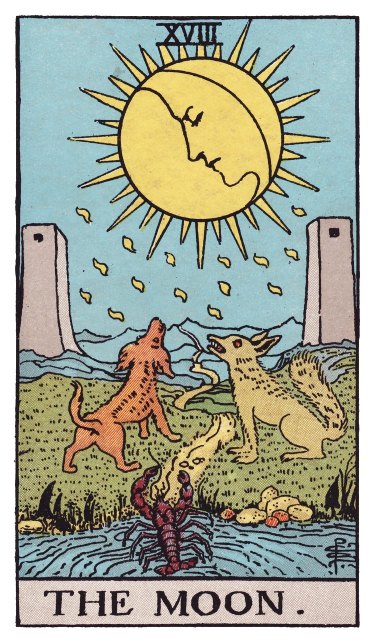
What's in the picture
-
1
The moon's face and falling dropsAbove the scene: a full moon with a face, neither friendly nor cruel, and fifteen drops of light falling like rain. Insight and confusion fall together.
-
2
A dog and a wolf howling at the moonOn the path: a dog and a wolf, both howling at the moon. The dog is the domesticated mind; the wolf is the wild mind. In moonlight you can't tell them apart.
-
3
A crayfish crawling out of the poolAt the bottom of the path: a pool with a crayfish emerging from it. The crayfish is the unconscious, coming up from the deep. What was submerged starts rising.
-
4
The winding path between two towersBetween two towers, a winding path leads away into the mountains. The path is real, but you can't see where it goes. The Moon won't show you the end.
Reversed
Four ways to read this card reversed. Which one depends on the question.
Blocked. You're in an uncertain stretch, and the way forward is real, but you won't take the next step until you can see more clearly.
Internal. Your situation is clearer than it feels, because the confusion and fear are coming from inside you.
Excess. After a long stretch in the fog, you've stopped believing there's a way through at all.
Shadow. Not knowing has become comfortable. If you found out the truth, you'd have to act on it.
How to read tarot reversals explains these four lenses and how to choose one. The readings for all 78 cards are also in Reading Reversals, a printable guide on Etsy.
Where it sits in the majors
The Major Arcana, in order
Twenty-two named cards, read as one sequence rather than a suit.
The Star restores and the Moon obscures, and putting them in that order is the deck being accurate instead of cruel. Recovery routinely comes before clarity. The Sun follows and resolves it completely, which makes this card the last dark one in the deck. Whatever the fog is doing, the sequence is explicit that you come out the other side, and that the next card is uncomplicated.
It sits second to last among the difficult cards, and that position is itself the reassurance. Every reading of the Moon is a reading of a card the deck has already decided you come through. Confusion, in this sequence, is a stage and never a verdict on you. The card after it settles that completely.

Reading a card is a skill, not a lookup
Little Grimoire teaches the deck's structure first, so an unfamiliar card is something you can reason about instead of search for. Chapter VI is the majors, card by card — including the imagery study you just read.
Free to start · No account needed to try a lesson