Home / Cards / Major Arcana / Death
Major Arcana
Death
Something genuinely ends here, and the ending is the point. Look past the figure to the sun coming up on the horizon: what this card describes is a passage, and passages have a far side.
- Number
- XIII
- Act
- Act II — the Inner World
- Element
- Water
- Endings
- Transformation
- Transition
- Release
- Change
What Death means
Something genuinely ends in this card and the ending is the subject. A job, a version of yourself, a way of living that had been running past its point: the passage is real and the card declines to soften it.
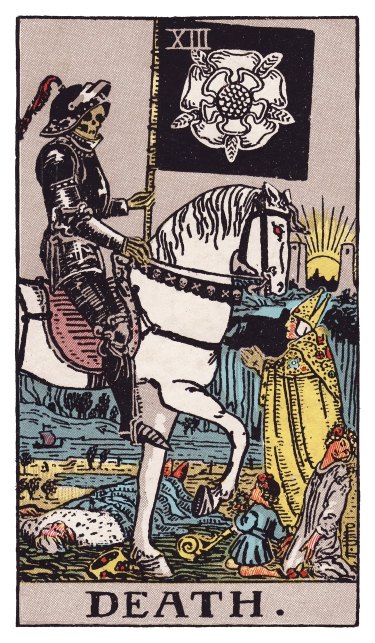
What it insists on alongside that is continuation. The sun is coming up on the horizon behind the figure, which is the part almost nobody mentions, and it changes the reading completely. This describes a passage, and passages have a far side. You arrive there different, and you do arrive.
Literal death is the reading that needs correcting. Death in a spread almost never announces that somebody is going to die, and taking it that way has probably frightened more beginners than every other card combined. The second misreading is subtler: people meet it as the worst card in the deck, as though drawing it means the reading has gone wrong. When something has been dragging on well past its point, it's among the more welcome cards to turn over. It names the ending that's already underway and stops you having to pretend otherwise.
When you'd see this
A chapter closes that you didn't want to end, and on the far side you're someone different.
You let go of something you've held for years, and the release feels clean instead of crushing.
Only afterward do you notice a phase had been ending the whole time, and that you've changed.
What's in the picture
-
1
The skeletal rider on a white horseThe rider is skeletal, in black armor, on a white horse. White is cleansing, daylight: Death is the cleanser. The skeleton is what's left at the end.
-
2
The black banner with a white roseA black banner carrying a white five-petaled rose, the same rose The Fool held. The rose reappears: through every ending, something clean passes through.
-
3
King, child, woman, priestAt the horse's feet: a king fallen, a child unafraid, a woman turning away, a priest in prayer. Endings treat everyone differently. The card judges none.
-
4
The sun rising between two towersIn the far background: a sun rising between two towers, already visible behind the rider. A new day is rising. Death is a passage, not a destination.
Reversed
Four ways to read this card reversed. Which one depends on the question.
Blocked. You're holding on to something that has reached its end, so the ending drags on and nothing new can start.
Internal. You've let go of something on the inside, but your daily life hasn't caught up with the change yet.
Excess. You end jobs and relationships the moment they get hard, before they've run their course.
Shadow. To make sure you're never the one left, you end relationships first, including good ones.
How to read tarot reversals explains these four lenses and how to choose one. The readings for all 78 cards are also in Reading Reversals, a printable guide on Etsy.
Where it sits in the majors
The Major Arcana, in order
Twenty-two named cards, read as one sequence rather than a suit.
The Hanged Man suspends and Death completes, and the deck puts them together because the second is what the first was waiting for. Temperance comes next and does the slow work of putting the pieces back into a life, which is why it can't come earlier. You can't integrate something that hasn't finished ending. These three sit at the floor of Act II and they're the hardest run of cards in the deck.
Notice how far in it sits. Thirteen cards of preparation before the deck is willing to describe an ending, and eight more waiting on the other side. Whatever this card is, the sequence is clear that it stops well short of being a conclusion.

Reading a card is a skill, not a lookup
Little Grimoire teaches the deck's structure first, so an unfamiliar card is something you can reason about instead of search for. Chapter VI is the majors, card by card — including the imagery study you just read.
Free to start · No account needed to try a lesson