Home / Cards / Major Arcana / The Hermit
Major Arcana
The Hermit
Withdrawal chosen on purpose is a different animal from withdrawal that happens to you. The lamp was always in his hand, and what the retreat provides is quiet enough to notice you've been carrying it.
- Number
- IX
- Act
- Act II — the Inner World
- Element
- Earth
- Solitude
- Introspection
- Guidance
- Inner wisdom
- Soul-searching
What The Hermit means
Withdrawal you've chosen is a completely different animal from withdrawal that's happened to you. The Hermit describes the first kind: a deliberate step back taken while you still had the option to stay, for the specific purpose of hearing yourself think.
The lantern was already in his hand before he climbed. That detail carries the card's real claim, which is that retreat delivers wisdom less from outside than by clearing enough space for you to notice what you'd been carrying the whole time. People come back from a week alone with things they already knew, stated plainly for the first time.
It reads as solitary and it's rarely lonely. There's a version of this card that gets treated as sad, an old man on a mountain with nobody around, and the mood is wrong. He's up there on purpose, and he intends to come down. The card is a round trip, and the descent counts as much as the climb. Wisdom that stays on the mountain does nobody any good, least of all the person holding it.
When you'd see this
You pull back from the group chat because you need to hear your own voice first.
Somewhere in the third mile of the walk you took alone, the committee in your head goes quiet.
A sabbatical, a real stop, and the stillness shows you what you already knew.
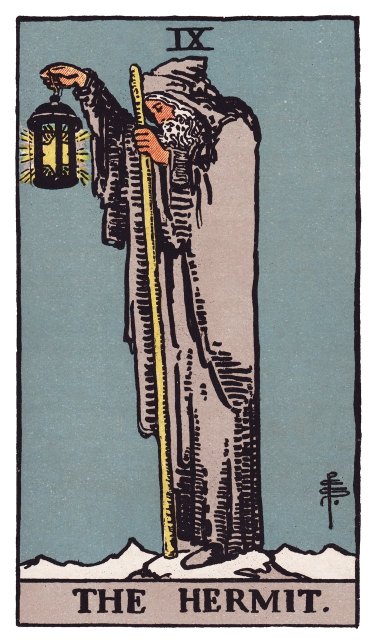
What's in the picture
-
1
Alone in gray robes on a snowy peakHe stands alone on a snowy peak, in plain gray robes, old but seasoned. The peak is elevation, not abandonment: solitude chosen for perspective, not escape.
-
2
The lantern with a six-pointed starHis raised lantern holds a six-pointed star, the Seal of Solomon: the light of self-knowledge that only stillness earns. He's the one with the light.
-
3
A long staff in his other handIn his other hand: a long staff. Unlike the Magician's wand, it points nowhere; it steadies him where he stands. It's what he leans on while he's listening.
-
4
His downward, contemplative gazeHis gaze is downward, toward the lantern, not out at the world. He's looking at the light he already has: the answer is in the lantern you're already holding.
Reversed
Four ways to read this card reversed. Which one depends on the question.
Blocked. You need time alone to think things through, but between your commitments and the people around you, you can't get the space.
Internal. You've found insight in your time alone, but you haven't brought any of it back to the people who could use it.
Excess. Your time alone has gone on too long, and the reflection has turned into isolation.
Shadow. You withdraw whenever things get hard and call it soul-searching, while the problems you left wait for you.
How to read tarot reversals explains these four lenses and how to choose one. The readings for all 78 cards are also in Reading Reversals, a printable guide on Etsy.
Where it sits in the majors
The Major Arcana, in order
Twenty-two named cards, read as one sequence rather than a suit.
Strength holds steady inside the situation and the Hermit steps outside it, which is the pair Act II opens with. Both are answers to the same difficulty and they use opposite motion. After him the Wheel of Fortune arrives and takes the question out of his hands entirely, since perspective earned in solitude still has to survive events you didn't choose. The sequence lets him have his mountain for exactly one card.
His light is also what gets carried forward. Everything in the rest of Act II happens to somebody who has already spent time alone with themselves, and the cards get considerably harder from this point on. Solitude, in this deck, is preparation.

Reading a card is a skill, not a lookup
Little Grimoire teaches the deck's structure first, so an unfamiliar card is something you can reason about instead of search for. Chapter VI is the majors, card by card — including the imagery study you just read.
Free to start · No account needed to try a lesson