Home / Cards / Major Arcana / The High Priestess
Major Arcana
The High Priestess
Some things you know before you can say them, and saying them too early costs you the knowing. This card sits in that gap, where attention has done its work and language hasn't caught up yet.
- Number
- II
- Act
- Act I — the Outer World
- Element
- Water
- Intuition
- Mystery
- Subconscious
- Inner knowledge
- Stillness
What The High Priestess means
Some things arrive before you can say them. The High Priestess describes that gap precisely, the interval where you already know how a conversation is going to go, or that a decision has been made somewhere below the level of argument, and you couldn't defend it yet if someone asked you to.
That kind of perception has to be earned. It comes from having paid attention over a long stretch without needing to announce what you noticed, and the card treats stillness as the working method instead of the absence of one. The temptation is always to reach for language too early, and language too early is how the knowing gets lost.
She holds what she knows without spending it. There's a version of this card that reads as passivity, a woman doing nothing between two pillars, and it misses that the withholding is the activity. What she's protecting is the part of an answer that hasn't finished forming. Readers who want a verdict from her tend to leave disappointed, and the disappointment is instructive.
When you'd see this
Something is wrong before anyone tells you, a friend lying or a job about to go sideways.
Sitting with a hard question, you let the answer come up from your body instead of your head.
You notice a pattern others are missing because you've been paying attention without saying anything.
What's in the picture
-
1
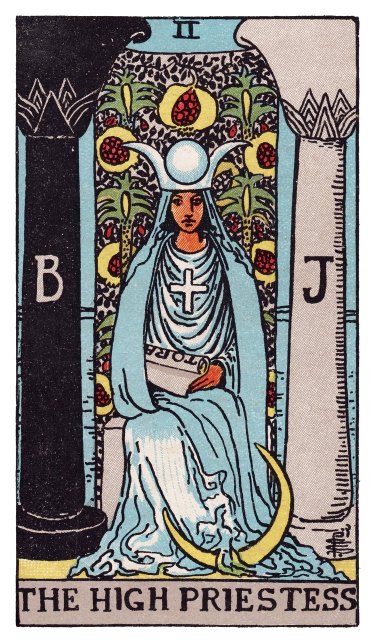
Between a black pillar and a white oneShe sits between a black pillar (B) and a white pillar (J), Boaz and Jachin: the threshold between what's known and what's hidden. She sees both.
-
2
The veil of pomegranatesBehind her: a veil stitched with pomegranates, an old symbol of hidden knowledge. The veil is permeable. She can see through it, but most cannot.
-
3
A crescent moon at her feetAt her feet: a crescent moon, the symbol of intuition, cycles, the unconscious. She is grounded in what most people reach toward only at night.
-
4
A partially hidden scroll in her lapIn her lap: a scroll marked TORA, partially hidden in her robes. The knowledge is real, but not to be shown in full.
Reversed
Four ways to read this card reversed. Which one depends on the question.
Blocked. Your intuition has an answer for you, but other people's opinions and a busy schedule drown it out.
Internal. Part of you already knows what's happening, but you haven't let yourself admit it.
Excess. You read hidden meaning into everything, and your hunches outweigh the plain facts in front of you.
Shadow. Keeping what you know to yourself becomes a way to hold power over others, and it costs you their trust.
How to read tarot reversals explains these four lenses and how to choose one. The readings for all 78 cards are also in Reading Reversals, a printable guide on Etsy.
Where it sits in the majors
The Major Arcana, in order
Twenty-two named cards, read as one sequence rather than a suit.
The Magician acts and the High Priestess receives, and the deck puts them side by side because it wants you to feel them as one pair instead of two cards. He directs energy outward through will; she lets it arrive. Then the Empress follows and takes the receptive quality somewhere else entirely, into growth and abundance you can touch. Between the two women sits the difference between knowing something and making something of it.
Her position also explains the pillars she sits between. Standing in a doorway makes her a threshold, and the sequence treats her as the point where the outward-facing cards briefly turn and look the other way.
Reading a card is a skill, not a lookup
Little Grimoire teaches the deck's structure first, so an unfamiliar card is something you can reason about instead of search for. Chapter VI is the majors, card by card — including the imagery study you just read.
Free to start · No account needed to try a lesson