Home / Cards / Major Arcana / Wheel of Fortune
Major Arcana
Wheel of Fortune
Much of what happens to you was never yours to steer. The wheel turns on its own schedule, and the available work is locating the still point at the axis where the turning stops throwing you.
- Number
- X
- Act
- Act II — the Inner World
- Element
- Fire
- Luck
- Karma
- Change
- Cycles
- Fate
What Wheel of Fortune means
Some of what happens to you was never available to steer. The Wheel names that plainly: the large pattern turns on a schedule of its own, promotions become demotions, and the same shape of relationship arrives for the third time wearing a different face.
What the card offers instead of control is orientation. The wheel has an axis, and the axis moves least. Finding the place you can stand while the rim goes round is a genuine skill, and it's mostly the practice of noticing that you're the same person in the good stretch and the bad one.
Fatalism would be the easy misreading and the card gives it no support. Nothing here says your choices are pointless. The card says the timing of the return isn't yours, and that recognising the pattern early is worth more than resenting it. There's also a quiet consolation in it. If the turn was never yours, the fall was no verdict on you, and neither was the rise. Both of those are harder to believe than they sound and both are worth practising.
When you'd see this
A promotion turns into a demotion six months later, and you're the same person either way.
Three times now, the same kind of friendship and the same ending, and this time you see it coming.
Something outside your control shifts everything, and the work becomes finding your footing again.
What's in the picture
-
1
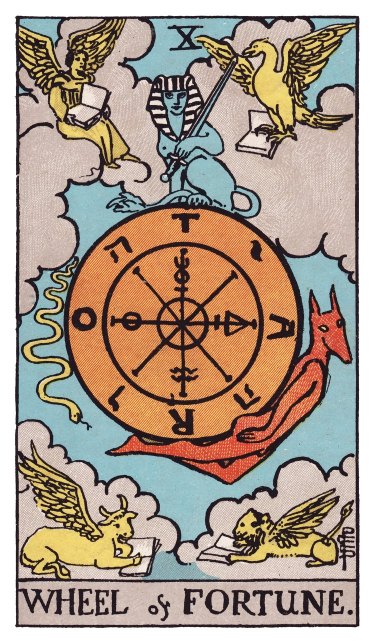
A great wheel suspended in a cloudy skyThe wheel itself, enormous, floating in clouds, marked with letters and alchemical symbols: TARO one way, ROTA the other. The pattern that turns regardless.
-
2
The sphinx atop the wheelAt the top: a sphinx holding a sword, the still point. It doesn't rise and fall; it sits at the axis. A place to stand that the turning doesn't throw you.
-
3
On the wheel: one rising, one fallingOn the wheel: a snake descending, an Anubis-like figure rising. Both were at the top once; both will be again. No position is permanent.
-
4
Four winged creatures reading booksIn each corner: a winged creature (angel, eagle, bull, lion) reading a book, the four fixed signs. They don't turn; they witness. The anchors don't turn.
Reversed
Four ways to read this card reversed. Which one depends on the question.
Blocked. A change you've been waiting for is overdue, and checking on it daily doesn't bring it any closer.
Internal. The cycle has already turned inside you, even though your circumstances look exactly the same.
Excess. One change follows another, and you can't get your footing before the next turn comes.
Shadow. Putting everything down to luck or fate lets you avoid responsibility for the choices that were yours.
How to read tarot reversals explains these four lenses and how to choose one. The readings for all 78 cards are also in Reading Reversals, a printable guide on Etsy.
Where it sits in the majors
The Major Arcana, in order
Twenty-two named cards, read as one sequence rather than a suit.
The Hermit went looking for perspective and the Wheel supplies it in a form he didn't ask for, which is why these two are neighbours. Justice comes next and narrows the frame back down, because after the largest possible view of cause and effect you have to face your own particular account. The Wheel is the impersonal version of consequence. The card immediately after it makes the same subject personal.
This is the middle of the deck and the placement suits it. Ten cards behind, eleven ahead, and a card about turning sitting exactly where the sequence itself pivots from one kind of question to another. Before it, you were mostly acting. After it, mostly responding.

Reading a card is a skill, not a lookup
Little Grimoire teaches the deck's structure first, so an unfamiliar card is something you can reason about instead of search for. Chapter VI is the majors, card by card — including the imagery study you just read.
Free to start · No account needed to try a lesson