Home / Cards / Major Arcana / The World
Major Arcana
The World
Completion that's real, for once. The circle closes on itself and everything the journey cost has been absorbed into whoever you are now, which is what makes the arrival feel like arrival.
- Number
- XXI
- Act
- Act III — the Transcendent
- Element
- Earth
- Completion
- Integration
- Accomplishment
- Wholeness
- Fulfillment
What The World means
Completion that's real, for once. The circle closes on itself, everything the journey cost has been absorbed into whoever you are now, and that absorption is what makes the arrival register as arrival instead of relief. Relief would fade. This holds.
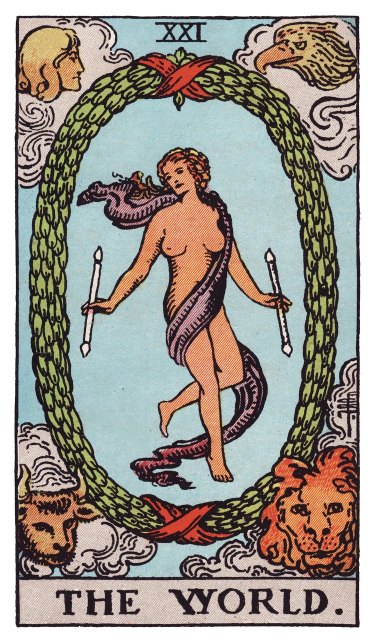
The card describes integration more than a finish line. You look back at a decade of material and find it's stopped being a set of lessons and become simply your character. The wreath around the dancing figure is closed, and the figure inside it is moving, which is the whole argument in one image.
What follows is another beginning, and the deck is deliberate about that. Wholeness here is the platform for the next cycle, and no kind of retirement from cycles. You start again from having enough, which is a materially different thing from starting again from lack. The dancer is worth a second look for that reason. Somebody who had arrived would be standing still. Arrival that stopped moving would be a monument, and the deck has no interest in building one.
When you'd see this
You finish something that took years, and standing in it you realize you became someone different.
Everything you went through made you into someone who can hold exactly this moment, and it is enough.
A lesson you've been learning for a decade stops being a lesson and starts being who you are.
What's in the picture
-
1
The dancer inside the laurel wreathAt the center: a dancing figure in a purple scarf, one leg crossed behind the other, the Hanged Man's pose, upright and moving. Surrender has become the dance.
-
2
Two wands held in the dancer's handsIn her hands: two wands, the Magician's wand, now doubled and balanced. She holds what was learned in both hands. The tools of the Magician are now fully hers.
-
3
The great laurel wreathAround her: a great laurel wreath, oval, tied with red ribbons at top and bottom. The wreath is the full cycle, closed, the circle arrived back at itself.
-
4
Angel, eagle, bull, lion in the cornersIn the four corners: the four winged creatures from the Wheel of Fortune, now no longer reading books. They are watching. What was turning is complete.
Reversed
Four ways to read this card reversed. Which one depends on the question.
Blocked. You've nearly finished something big, but the last piece is out of your hands.
Internal. You've come full circle without marking the ending or telling anyone what it means to you.
Excess. You need every project tied off so neatly that you leave no room for anything new to start.
Shadow. You treat the achievement as the end of the road and stop growing, even though the next cycle is already waiting.
How to read tarot reversals explains these four lenses and how to choose one. The readings for all 78 cards are also in Reading Reversals, a printable guide on Etsy.
Where it sits in the majors
The Major Arcana, in order
Twenty-two named cards, read as one sequence rather than a suit.
Judgement asks and the World is the answer accepted, which is why these two close the sequence together. After this the deck returns to the Fool, and the return is the point and never a technicality. The figure who begins again has been through all twenty-one cards and can still leap, which is what the zero meant the first time you saw it. The journey is a circle and this card is where you notice.
Twenty-two cards, and the final one hands you back to the first. Whatever else the Major Arcana is doing, it declines to end, and that refusal is the most consistent thing about it. The circle is the argument.

Reading a card is a skill, not a lookup
Little Grimoire teaches the deck's structure first, so an unfamiliar card is something you can reason about instead of search for. Chapter VI is the majors, card by card — including the imagery study you just read.
Free to start · No account needed to try a lesson