Home / Cards / Major Arcana / The Lovers
Major Arcana
The Lovers
Choices at this level don't sort into right and wrong. They sort into who you become, which is why the card outlasts the decision that prompted it and why the outcome matters less than the direction.
- Number
- VI
- Act
- Act I — the Outer World
- Element
- Air
- Love
- Union
- Choices
- Values
- Relationships
What The Lovers means
Every so often you make a choice that turns out to have been about identity. The Lovers describes that kind, the one where the practical arguments on both sides come out roughly even and what actually decides it is which version of yourself you're willing to be afterward.
The card outlasts the decision that prompted it. You commit to a person, a piece of work, a set of values you'd have to defend in an argument, and the commitment starts shaping you almost immediately. Six years later the choice has stopped being something you made. It's something you're built out of.
Most people meet this card expecting a forecast about romance, a soulmate on the way or a relationship confirmed as fated. It surfaces around relationships often, because that's where the identity-shaping decisions cluster, and the subject is the choosing itself. It reads just as cleanly on the job you took, the faith you kept, or the city you decided to stay in. The related assumption, that the card only speaks to people already partnered or currently looking, misses in the same direction: this is a question you can answer completely alone.
When you'd see this
Two paths, and what actually matters is who you'll become on either one.
You commit to a person or a cause, and the commitment itself changes you.
Saying yes to one thing means choosing against something else you wanted, and you say it anyway.
What's in the picture
-
1
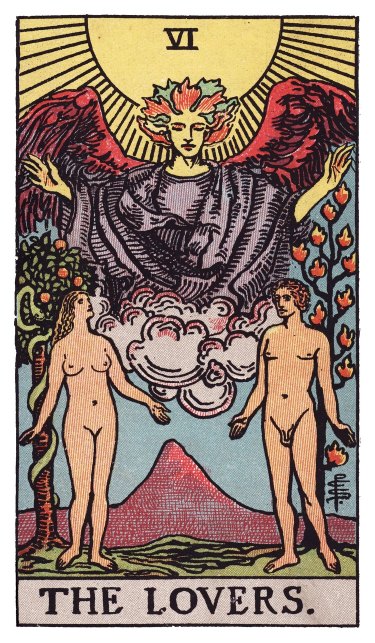
A man and a woman, naked in a gardenTwo figures, naked, in a garden: Eden, the setting for the primal choice. Nakedness means without pretense, the only state for a choice that changes you.
-
2
The angel and the sun above themAbove them: an angel with wings spread, the sun radiating behind. The angel blesses the choice but does not make it. Divine attention, not divine command.
-
3
Two trees: serpent and flamesBehind the woman, the Tree of Knowledge with a serpent; behind the man, the Tree of Life with twelve flames. Two orientations: knowing more, or being more.
-
4
The distant mountain between themBetween them, far off: a mountain, the peak they may ascend together. Not today. The choice they make here determines whether they'll climb it.
Reversed
Four ways to read this card reversed. Which one depends on the question.
Blocked. The connection is there on both sides, and the relationship is stuck because neither of you will commit first.
Internal. You know who or what you're choosing, but you haven't told the person it affects.
Excess. You've merged with the other person to the point where you've lost track of what you want for yourself.
Shadow. Your commitment has become part of who you are, so you stay even when the relationship goes against what you value.
How to read tarot reversals explains these four lenses and how to choose one. The readings for all 78 cards are also in Reading Reversals, a printable guide on Etsy.
Where it sits in the majors
The Major Arcana, in order
Twenty-two named cards, read as one sequence rather than a suit.
The Hierophant hands you an answer and the Lovers asks whether you'll take it. That's the pivot, and it's why this card sits exactly here in Act I. After it the Chariot arrives, and the Chariot only works because a choice has been made: you can't align yourself toward a direction you haven't picked. The sequence spends five cards building an outer world and then quietly makes it your problem.
Notice too that this is the first card where nobody can act on your behalf. The Emperor could rule for you and the Hierophant could teach you. This one requires you to be present and paying attention. It's the first genuinely personal card in the deck.

Reading a card is a skill, not a lookup
Little Grimoire teaches the deck's structure first, so an unfamiliar card is something you can reason about instead of search for. Chapter VI is the majors, card by card — including the imagery study you just read.
Free to start · No account needed to try a lesson