Home / Cards / Major Arcana / The Emperor
Major Arcana
The Emperor
Structure gets a bad name until you've lived without it. This card describes the scaffolding that lets everything else stand, where rules are stated plainly and someone is visibly willing to be accountable for them.
- Number
- IV
- Act
- Act I — the Outer World
- Element
- Fire
- Authority
- Structure
- Stability
- Leadership
- Protection
What The Emperor means
Structure has a bad reputation until you've worked somewhere without it. The Emperor is the scaffolding that lets everything else stand up: rules stated where people can read them, boundaries that hold when tested, and somebody visibly willing to be answerable for both.
The card describes authority that has accepted its own cost. Being the one who decides means being the one who's wrong in public when the decision is wrong, and the figure on this throne has taken that trade knowingly. Power that dodges the accounting is a different card entirely, further along in the deck and much less comfortable.
He's stone where the Empress is field, and the contrast does real work. What she grows would run wild without edges; what he builds would be empty without something to contain. Neither one is the mature position on its own, which is part of why the sequence gives you both before it moves on. The deck gives you the pair and then moves on, which suggests it considers the argument settled.
When you'd see this
You take charge of a chaotic situation and start making the decisions no one else will make.
You finally set one firm boundary with a family member, and the whole dynamic shifts.
Running the company or the household, you're the one everyone knows what to expect from.
What's in the picture
-
1
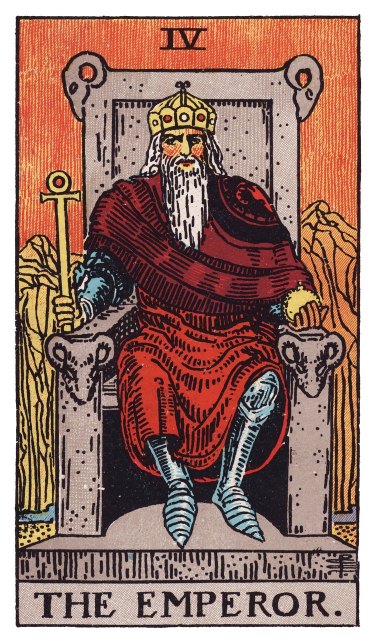
The stone throne with rams' headsHis throne is stone, carved with four rams' heads, the symbol of Aries: first, decisive, willing to lead. A seat built to last and built to lead.
-
2
A direct, forward-facing postureHe faces directly forward and meets the viewer head-on. The Emperor is accountable: visible, deciding, willing to be seen making the call.
-
3
An ankh and an orb held in his handsIn one hand: an ankh (life). In the other: an orb (dominion over the world). He rules over the living, tangible world, real people and real lands.
-
4
Armor visible beneath his royal robesUnder his robes: armor. His rule is earned through effort and capable of being defended. He has fought for the right to set the rules.
Reversed
Four ways to read this card reversed. Which one depends on the question.
Blocked. The rules and plans you've set up would work, if anyone followed them.
Internal. You keep strict rules for yourself, but you hold back from leading, even when the people around you need someone to take charge.
Excess. You add rules and checks until every small decision needs your approval, and nothing can move without you.
Shadow. Being in charge matters more to you now than the people you're responsible for.
How to read tarot reversals explains these four lenses and how to choose one. The readings for all 78 cards are also in Reading Reversals, a printable guide on Etsy.
Where it sits in the majors
The Major Arcana, in order
Twenty-two named cards, read as one sequence rather than a suit.
The Empress creates through fertility and the Emperor creates through order, and the deck sets them adjacent so the difference registers as method instead of temperament. After him comes the Hierophant, who takes the Emperor's structures and adds the one thing they lack, which is a way of passing them down. Rules that die with the person who made them aren't yet a tradition. That handoff is the whole business of the card that follows.
Read the run from Magician to Hierophant and it's a five-card argument about where authority comes from: your own will, then perception, then growth, then order, and finally inheritance. Each one qualifies the one before it.

Reading a card is a skill, not a lookup
Little Grimoire teaches the deck's structure first, so an unfamiliar card is something you can reason about instead of search for. Chapter VI is the majors, card by card — including the imagery study you just read.
Free to start · No account needed to try a lesson