Home / Cards / Major Arcana / The Sun
Major Arcana
The Sun
Good things happen too, and this card declines to complicate them. Direct light in an ordinary garden, something working exactly as it should, and permission to enjoy it without hedging the enjoyment.
- Number
- XIX
- Act
- Act III — the Transcendent
- Element
- Fire
- Joy
- Success
- Optimism
- Vitality
- Clarity
What The Sun means
Good things happen too, and this card declines to complicate them. Direct light, an ordinary garden, something working the way it was supposed to, and permission to enjoy it without adding a caveat.
The tarot spends a lot of its length on difficulty, so a card with no shadow in it does real structural work. What the Sun describes is the state after the long passage: vitality that needs no defending, and the specific relief of having nothing to manage for a while. Everything works. Nothing is being tested. That's the whole content, and the card's confidence in offering it without apology is unusual enough to be worth pausing on.
Its posture is worth noticing. The figure is unguarded, unselfconscious, receiving where he might have been achieving. That's the condition the card is pointing at, and most adults find it considerably harder to occupy than any of the difficult cards that came before it. Difficulty has a shape you can describe and a role you can justify. Ease has neither, and sitting in it without reaching for the next problem is a discipline most people never quite acquire.
When you'd see this
A child laughs across the room and you notice your own face is open, no armor on it at all.
You sit in the sun with a friend after a long stretch of that not happening, and the warmth is the point.
The thing you've been working on works cleanly, and you let yourself enjoy it without hedging.
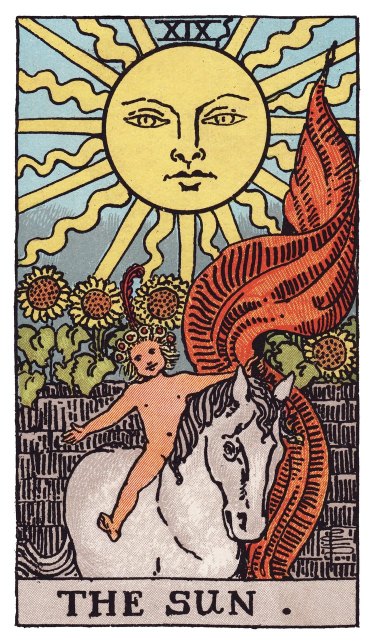
What's in the picture
-
1
The sun's face, straight and wavy raysDominating the scene: a large sun with a face, rays alternating straight and wavy. Direct light, not reflected. After the Moon, everything is visible.
-
2
The naked child on a white horseBelow the sun: a naked child on a white horse, arms outstretched. Nakedness here is innocent, not vulnerable, unselfconscious joy, arms open to receive.
-
3
A red banner held in the child's handThe child holds a red banner streaming behind. Red for life force, vitality, reality. The banner moves: joy is not static. The child is actively living it.
-
4
The garden wall and sunflowersBehind the child: a stone wall with four sunflowers reaching above it. An ordinary garden, a real place. Joy here isn't rare. It's in the ordinary world.
Reversed
Four ways to read this card reversed. Which one depends on the question.
Blocked. You hold off on enjoying how well life is going, as if you're waiting for something to go wrong.
Internal. You feel happy and full of energy again, though you haven't let anyone see it.
Excess. You need to feel great all the time, and anything less than happy feels like failure.
Shadow. Your confidence that it will all go well makes you careless, so you stop checking the details that could still go wrong.
How to read tarot reversals explains these four lenses and how to choose one. The readings for all 78 cards are also in Reading Reversals, a printable guide on Etsy.
Where it sits in the majors
The Major Arcana, in order
Twenty-two named cards, read as one sequence rather than a suit.
The Moon walks you through what you couldn't see and the Sun arrives with everything visible, which is why the deck places them consecutively and why the contrast is so abrupt. Judgement follows and asks something of you again, so this card is a genuine rest instead of an ending. Three cards remain after it. The Sun is the deck's clearest statement that the difficult stretches are passages you cross.
Read the last five in order and the shape is unmistakable: collapse, then recovery, then confusion, then clarity, then a summons. The deck resolves the difficulty before it asks anything of you, which is the reverse of how most stories get built.

Reading a card is a skill, not a lookup
Little Grimoire teaches the deck's structure first, so an unfamiliar card is something you can reason about instead of search for. Chapter VI is the majors, card by card — including the imagery study you just read.
Free to start · No account needed to try a lesson