Home / Cards / Major Arcana / The Hierophant
Major Arcana
The Hierophant
Inherited knowledge arrives with conditions attached. Someone taught you this, and the teaching came bundled with a lineage and its expectations, so sorting the gift from the constraint becomes most of what belonging asks of you.
- Number
- V
- Act
- Act I — the Outer World
- Element
- Earth
- Tradition
- Guidance
- Conformity
- Belief
- Institutions
What The Hierophant means
Somebody taught you almost everything you know how to do, and the teaching arrived with conditions attached. The Hierophant is that transaction: knowledge handed from one person to the next inside an institution that shapes what's transmissible and what quietly gets dropped along the way.
The card holds the gift and the weight at the same time. Belonging to something older than yourself gives you a hundred years of other people's mistakes for free, and it also gives you their assumptions, their blind spots, and a set of expectations about how you'll behave. Sorting which is which turns out to be most of the work of belonging to anything.
He sits above two students, and the geometry matters. This is knowledge that flows in a direction, which is efficient, and which is also the thing that makes a tradition hard to argue with from inside it. It also explains why the card can feel airless to anyone who has outgrown the room they learned in, and why leaving is so much more complicated than disagreeing.
When you'd see this
Teaching your kid the thing your grandmother taught you, down to the way the family does it.
You decide to work with a senior mentor even though you could probably figure it out alone.
Comforted and constrained at once by the institution you belong to, you're sorting which is which.
What's in the picture
-
1
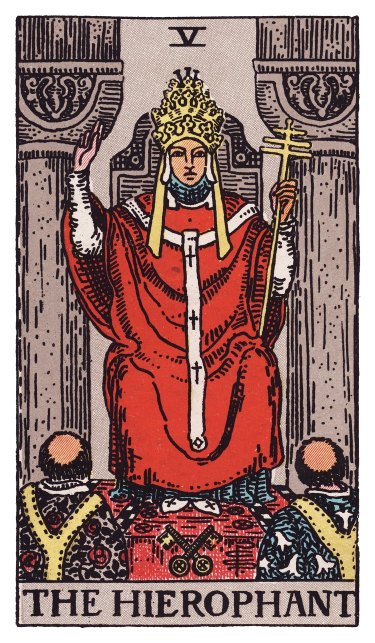
Between two pillars in a templeHe sits between two pillars, but these are the pillars of an institution, public and organized. What he knows has been codified, taught, passed down.
-
2
A triple crown on his headOn his head: a triple crown, the papal tiara. Institutional authority: sanctioned, titled, recognized. The Emperor's rule is civic; his is spiritual.
-
3
Two acolytes kneeling before himAt his feet: two acolytes kneeling, receiving instruction. This is the transmission at the heart of the card, tradition passed down, person to person.
-
4
Crossed keys at his feetBetween him and the acolytes: crossed keys, the authority to bind and loose. He holds the gates of membership. Tradition has insiders and outsiders.
Reversed
Four ways to read this card reversed. Which one depends on the question.
Blocked. You want guidance from a teacher or a tradition, but you haven't found one that fits you yet.
Internal. Your beliefs guide you privately, outside any group or tradition that shares them.
Excess. You follow the rules and rituals so closely that you've forgotten why they mattered in the first place.
Shadow. You let the tradition do your thinking for you and stop questioning what you were taught.
How to read tarot reversals explains these four lenses and how to choose one. The readings for all 78 cards are also in Reading Reversals, a printable guide on Etsy.
Where it sits in the majors
The Major Arcana, in order
Twenty-two named cards, read as one sequence rather than a suit.
The Emperor makes the rules and the Hierophant is how they survive him. That's the reason the sequence puts them together, and the reason this card closes the run of authority figures. What follows is the Lovers, where all of it gets tested against a single person's choice, and the inherited answer suddenly has to compete with a decision only you can make. Act I moves from the world telling you who to be toward you deciding it.
It's also the last comfortable card in the act. Everything to this point has described a world with answers already sitting in it. The next card takes the answers away and hands you a decision nobody else can make.

Reading a card is a skill, not a lookup
Little Grimoire teaches the deck's structure first, so an unfamiliar card is something you can reason about instead of search for. Chapter VI is the majors, card by card — including the imagery study you just read.
Free to start · No account needed to try a lesson