Home / Cards / Major Arcana / The Hanged Man
Major Arcana
The Hanged Man
Suspension here is voluntary, which is the entire difference. Stopping on purpose shows you what all that motion was hiding, and the surrender turns out to be a form of intelligence with a view attached.
- Number
- XII
- Act
- Act II — the Inner World
- Element
- Water
- Surrender
- New perspective
- Pause
- Letting go
- Sacrifice
What The Hanged Man means
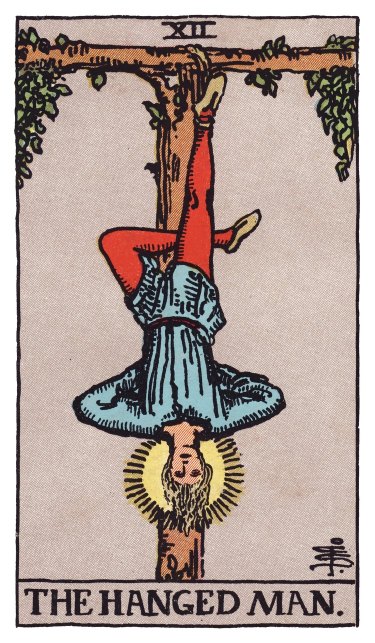
The Hanged Man put himself there. Nothing in the image suggests capture, and the whole reading turns on that: this is a pause taken deliberately, at cost, because the person taking it has worked out that motion was part of the problem.
What suspension buys is a change of angle. Stop pushing on something for two weeks and the answer often arrives during the gap, less because waiting is magic than because the pushing had been crowding out everything that wasn't the push. The card is the argument for the gap.
His expression is serene and that's the detail that tells you which card this is. Struggle in the same position would make it a different image entirely. Surrender here counts as intelligence instead of defeat, and the difference is whether you chose it. Which makes this one of the few cards that measures an intention and not an event. The same posture, imposed on you, would belong somewhere else entirely in the deck. What makes it wisdom is that you climbed up there yourself and can climb down whenever you decide to.
When you'd see this
You stop pushing on the problem for two weeks, and the answer arrives in the stillness.
Accepting a situation you can't change, after exhausting yourself against it, becomes the first step through.
Illness or travel puts you outside your own life a moment, and what mattered yesterday stops mattering.
What's in the picture
-
1
Hanging from a T-shaped treeA living T-shaped tree, still in leaf, and a figure hanging by one foot only. He could get down; he chooses not to. The pose is ritual.
-
2
A golden halo surrounding his headAround his head: a golden halo, radiant. This is revelation, not suffering. Upside-down is the position of seeing, a view that cost movement and gave clarity.
-
3
The free leg bent into a 4His free leg is bent behind his hanging leg, forming the numeral 4: deliberate, composed, intentional. A sign made on purpose. Stillness chosen, not imposed.
-
4
His calm, serene expressionHis face is serene. No distress, no strain. The same pose with a panicked face would be a different card. Surrender is the act of letting the view change you.
Reversed
Four ways to read this card reversed. Which one depends on the question.
Blocked. You keep forcing it when you know it's time to stop pushing and let go.
Internal. Your view of the situation has turned completely around, and so far you're the only one who knows.
Excess. You stay paused so long that the waiting stops being a choice and becomes a way of life.
Shadow. You make a show of your sacrifice and take pride in putting your own life on hold.
How to read tarot reversals explains these four lenses and how to choose one. The readings for all 78 cards are also in Reading Reversals, a printable guide on Etsy.
Where it sits in the majors
The Major Arcana, in order
Twenty-two named cards, read as one sequence rather than a suit.
Justice hands you a clear account and the Hanged Man declines to act on it yet, which is a stranger pairing than it looks and a deliberate one. Death follows, and follows directly, because a pause held long enough eventually stops being a pause. Something has to end. These three cards run the full arc from seeing the situation, to suspending your response, to letting the thing actually finish.
The suspension has a limit built into it. Nobody hangs there permanently, and the card immediately following makes that explicit in the least gentle way the deck has available. What comes next has been visible since Justice, and the pause is the last stretch of ground before it. Nobody arrives at Death unprepared in this ordering.

Reading a card is a skill, not a lookup
Little Grimoire teaches the deck's structure first, so an unfamiliar card is something you can reason about instead of search for. Chapter VI is the majors, card by card — including the imagery study you just read.
Free to start · No account needed to try a lesson