Home / Cards / Major Arcana / The Magician
Major Arcana
The Magician
Power here looks less like summoning and more like recognizing. Everything required is already on the table, and the work is knowing which tool the moment asks for and having the discipline to pick it up.
- Number
- I
- Act
- Act I — the Outer World
- Element
- Air
- Willpower
- Skill
- Manifestation
- Resourcefulness
- Action
What The Magician means
Everything the Magician needs is already on the table. That's the claim the card makes, and it's a harder one than it sounds, because the work it describes has nothing to do with acquiring anything. It's the discipline of looking at what you've already got and knowing which piece the moment is asking for.
He stands between what's above him and what's below, which is the old way of saying that he turns intention into an actual result. The card marks the switch from wanting to making. Something that had been circling in your head acquires a first physical form, and the form is usually much smaller and more ordinary than the wanting was.
One misreading dominates, and it turns him into a showman. Stage magic is illusion performed for an audience, and the tools in front of him were never props for a trick. They're the four suits, which is to say the whole working vocabulary of the deck, laid out and available to anyone who'll pick one up.
When you'd see this
Everything you know how to do finally points at one thing, and you sit down and make it real.
Walking into the meeting, you have the tools and the steadiness to turn intent into outcome.
You start a creative project and realize you already have everything you need.
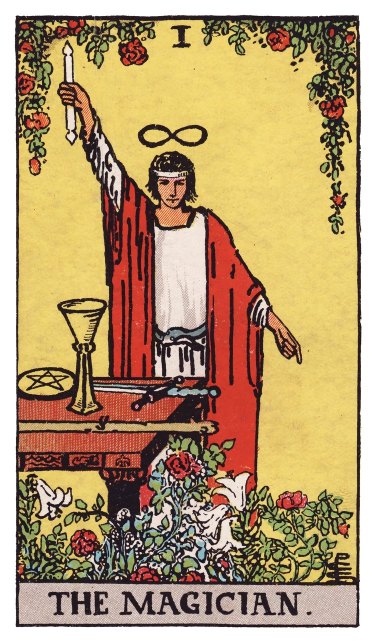
What's in the picture
-
1
One hand raised, one pointing downHis right hand raises a wand toward the sky; his left points down to the earth. As above, so below: he's a channel, directing power, not generating it.
-
2
A table with all four suit symbols on itOn the table: a wand, a cup, a sword, and a pentacle, every suit. All the tools are already there. He sees what's in front of him and uses it.
-
3
An infinity symbol above his headAbove him: the lemniscate, the infinity symbol. Mastery of the eternal. What he does now connects to what came before and after.
-
4
Red roses and white lilies at his feetAt his feet, red roses (passion, desire) and white lilies (purity, clarity). His will is both passionate and clean: desire channeled through discipline.
Reversed
Four ways to read this card reversed. Which one depends on the question.
Blocked. You keep waiting for the right moment to start, even though you already have everything you need to make your idea real.
Internal. So far your project exists only as a plan, worked out down to the last detail.
Excess. You make things happen so often that you stop asking whether any of it needed doing.
Shadow. You use your skill to manipulate people, and sooner or later you start fooling yourself as well.
How to read tarot reversals explains these four lenses and how to choose one. The readings for all 78 cards are also in Reading Reversals, a printable guide on Etsy.
Where it sits in the majors
The Major Arcana, in order
Twenty-two named cards, read as one sequence rather than a suit.
The Fool arrives with nothing but the willingness to move. The Magician is what that willingness looks like once it's found its hands, and the High Priestess directly after him is the same power turned inward and held still. He acts outward; she listens. Reading the three in order gives you the shape of Act I's opening argument: you begin, you make, and then you learn that making isn't the only way of knowing.
Taken as a run, the first three cards hand you a complete apparatus: something to want, something to do it with, and something to notice with. The deck spends the rest of Act I furnishing the world that apparatus has to work in.

Reading a card is a skill, not a lookup
Little Grimoire teaches the deck's structure first, so an unfamiliar card is something you can reason about instead of search for. Chapter VI is the majors, card by card — including the imagery study you just read.
Free to start · No account needed to try a lesson