Home / Cards / Major Arcana / Justice
Major Arcana
Justice
Clear sight is the whole of it. Cause lines up with effect, the account gets read as it actually stands, and the discomfort of looking straight at it is what makes any real correction possible.
- Number
- XI
- Act
- Act II — the Inner World
- Element
- Air
- Fairness
- Truth
- Law
- Cause and effect
- Clarity
What Justice means
Justice is about seeing what's actually there. Cause lines up with effect, the account gets read as it stands, with your preferences left out, and the discomfort of looking straight at it is exactly what makes any correction possible.
The card is often read as punishment and it doesn't behave like one. There's no malice in an accurate measurement. What makes it hard is that accuracy includes the part you were hoping nobody had noticed, and once a thing has been named honestly you can't go back to the comfortable version of it.
Her sword points up and her scales stay level, and the two gestures belong together. Clarity with no willingness to act on it is just commentary. The card describes the moment where you both see the situation properly and accept what seeing it obliges you to do. Most people can manage one half of that. The card wants both, in the same breath, which is why it reads as demanding even though nothing about it is punitive.
When you'd see this
You finally name what you have been doing wrong in the relationship, and the naming corrects it.
A consequence you saw coming months ago arrives, and facing it turns out lighter than dodging it was.
You do the honest review of the year, what you actually did measured against what you meant to do.
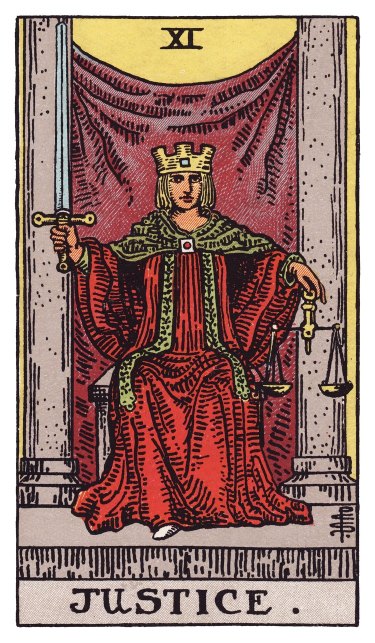
What's in the picture
-
1
The seated figure with scalesScales in her left hand, the instrument of honest accounting. Not judgment in the cruel sense: accurate weighing. An honest measurement before any verdict.
-
2
The raised double-edged swordHer right hand raises a double-edged sword, point up: truth that cuts both ways, toward you and away. Truth is truth whether it favors you or not.
-
3
Her open, unblinking eyesHer eyes are open, not blindfolded. The courthouse Justice is impartial by not seeing; this Justice sees everything. Truth is unflinching sight.
-
4
A red robe and a small crownHer robe is red (life force, what actually is) and her crown is small but real, earned authority, not decoration. She's a working principle, cause and effect.
Reversed
Four ways to read this card reversed. Which one depends on the question.
Blocked. You can see the fair outcome clearly, but you're waiting on people who won't make the decision.
Internal. In private, you've admitted the truth, including your own part in it.
Excess. You're so focused on being completely fair that you weigh both sides over and over without deciding.
Shadow. You hold everyone else strictly to account but go easy on yourself, and people notice the double standard.
How to read tarot reversals explains these four lenses and how to choose one. The readings for all 78 cards are also in Reading Reversals, a printable guide on Etsy.
Where it sits in the majors
The Major Arcana, in order
Twenty-two named cards, read as one sequence rather than a suit.
The Wheel turns without reference to you and Justice reads the ledger you personally ran up, which is the reason the deck places them in that order. What follows is the Hanged Man, and the sequence there is almost funny: you get an honest account of your situation, and the next instruction is to stop moving. Justice tells you what's true. The card after it says that acting on it immediately would be the wrong response.
It's also the second of three cards that each remove something. The Wheel takes away control, Justice takes away deniability, and the Hanged Man takes away momentum. By the time Death arrives you're carrying very little.

Reading a card is a skill, not a lookup
Little Grimoire teaches the deck's structure first, so an unfamiliar card is something you can reason about instead of search for. Chapter VI is the majors, card by card — including the imagery study you just read.
Free to start · No account needed to try a lesson