Home / Cards / Major Arcana / The Devil
Major Arcana
The Devil
Nothing supernatural is happening in this image. The chains hang loose enough to lift off, and the figures stay because a story about why they can't leave has become more convincing than the loose chain.
- Number
- XV
- Act
- Act III — the Transcendent
- Element
- Earth
- Bondage
- Materialism
- Addiction
- Shadow self
- Excess
What The Devil means
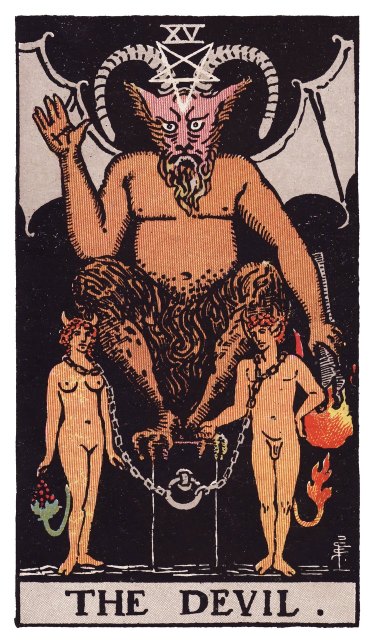
Nothing supernatural is happening in this image. The chains around the two figures hang loose enough to lift off over their heads, and they've stayed anyway, which is the whole of what the card is describing.
What holds people in place is usually a story about why leaving isn't possible. The habit you can't drop, the role you can't put down, the arrangement that diminishes you and would apparently cost too much to change. The card's argument is that the impossibility is doing the work, and that the impossibility is a belief, and beliefs can be examined.
Both of the usual readings get in the way. Treating the figure as an actual demonic power to be feared makes the card supernatural when its content is entirely ordinary, and it hands away the only useful thing on offer, which is agency. The related reading has the pair held captive by an external enemy against their will. Look at the chains. Nobody is holding them there. Both readings share the same shape, and it's worth naming: each one relocates the power to somebody else. That's what makes them comfortable, and it's why the card keeps having to be corrected.
When you'd see this
You keep going back to a habit you know isn't serving you, and the story about why is the chain.
Leaving the dynamic that diminishes you feels impossible, until the impossibility looks like a choice.
The role has your name on it now, and letting it go feels like dying, though it's cost you for years.
What's in the picture
-
1
Two figures chained at the Devil's feetTwo figures, a man and a woman, chained to a black cubic block: the Lovers, now bound. What was once chosen has become what you feel you can't leave.
-
2
Loose chains around their necksLook at the chains. They hang loosely; the loops are wide enough to lift off. The figures are not trapped. The bondage is belief, not force.
-
3
The inverted pentagramAbove the Devil's brow: an inverted pentagram. Upright, it means spirit ruling matter; inverted, matter ruling spirit, appetite running the show.
-
4
The torch pointing downwardIn the Devil's hand: a torch, pointing downward. Flame usually rises; downward flame is energy spent on consumption, not growth. Stuck in the wrong direction.
Reversed
Four ways to read this card reversed. Which one depends on the question.
Blocked. A habit or a pattern has a hold on you that you can't see clearly yet, so you haven't started to loosen it.
Internal. You feel the pull of the pattern every day, but you hide it so well that your friends and family have no idea.
Excess. You give in to the habit more and more, and the deeper it gets, the more it feels like proof you can't stop.
Shadow. What held you is gone, but you stay where it left you, because the story about why you can't leave still feels true.
How to read tarot reversals explains these four lenses and how to choose one. The readings for all 78 cards are also in Reading Reversals, a printable guide on Etsy.
Where it sits in the majors
The Major Arcana, in order
Twenty-two named cards, read as one sequence rather than a suit.
Temperance closed Act II with a person at peace, and the Devil opens Act III by finding the compromise inside the peace. The Tower comes next and it comes fast, because the arrangement described here is unstable by construction and something eventually strikes it. These two are a single event caught at two moments: the bondage you could see if you looked, and the collapse that arrives when you don't.
It's also the first card of the final act, and the placement is pointed. Act III opens with the thing you'd made your peace with, which suggests the deck considers an unexamined peace the most dangerous of the three positions.

Reading a card is a skill, not a lookup
Little Grimoire teaches the deck's structure first, so an unfamiliar card is something you can reason about instead of search for. Chapter VI is the majors, card by card — including the imagery study you just read.
Free to start · No account needed to try a lesson