Home / Cards / Major Arcana / The Chariot
Major Arcana
The Chariot
Victory here is internal before it's visible. Parts of you that had been pulling against each other line up, and what follows feels like momentum only because the friction has finally gone.
- Number
- VII
- Act
- Act I — the Outer World
- Element
- Water
- Control
- Willpower
- Victory
- Determination
- Momentum
What The Chariot means
The Chariot is a victory that happened internally before anything showed on the outside. Parts of you that had been pulling in opposite directions line up, and the movement that follows feels like momentum mostly because the resistance has finally gone.
That's why the card reads as effortful and calm at once. Anyone who's finished a long project knows the stretch where the work stops being a fight with yourself and becomes simply the next thing you do each morning. Nothing got easier. You stopped spending half your strength on the argument.
Control here means coherence more than force. The two sphinxes in front of him point different ways and he isn't whipping them into agreement, which is the detail most readings skip. He's holding a direction steadily enough that they've come round to it. There's a reason the card sits at the end of the outer sequence. Everything before it was about assembling the pieces of a self that can act; this is the first one where all the pieces move together, and the deck immediately follows it by asking a harder question.
When you'd see this
You push through the last hard stretch of a long project by sheer refusal to quit.
Competing parts of you finally point the same way, and the thing you were stuck on gives.
Months of training, and on race day the work itself carries you across.
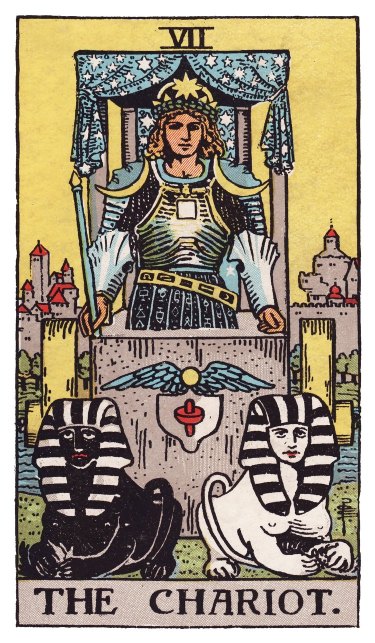
What's in the picture
-
1
Standing upright in a stone chariotHe stands upright in a stone chariot: not seated, commanding, and the chariot itself is stone, heavy and enduring. Deliberate, disciplined momentum.
-
2
A black sphinx and a white onePulling the chariot: two sphinxes, one black and one white, opposing forces. He holds no reins. He's mastered his own opposing impulses, so they pull together.
-
3
A canopy of stars above his headAbove him: a canopy of stars. Divine backing. He isn't alone in the charge. Disciplined will aligned with something larger is the engine of victory.
-
4
Armored shoulders and a crowned helmHis shoulders are armored; his helm is crowned with stars. Ready for opposition and backed by the cosmos. Not invincible: equipped.
Reversed
Four ways to read this card reversed. Which one depends on the question.
Blocked. Until two parts of you want the same thing, you can't push forward, however determined you are.
Internal. Your determination is all going into an inner struggle, so from the outside it looks like nothing is moving.
Excess. You're so set on winning that you drive on long after the goal has changed or stopped mattering.
Shadow. You need to be in control and to win, so every disagreement becomes a contest and people feel run over.
How to read tarot reversals explains these four lenses and how to choose one. The readings for all 78 cards are also in Reading Reversals, a printable guide on Etsy.
Where it sits in the majors
The Major Arcana, in order
Twenty-two named cards, read as one sequence rather than a suit.
The Lovers makes the choice and the Chariot executes it, which is why these two are adjacent and why the Chariot closes Act I. Everything up to here has been the outer world: making, ordering, inheriting, deciding. Strength follows immediately and moves the whole question inside, taking up the same problem of mastery and answering it in a way that would have been unrecognisable four cards ago. The deck changes register here, and this card is the last one facing outward.
Read the two acts against each other and the design shows through: seven cards facing outward, seven facing in, with this one as the hinge. Whatever the Chariot won, Act II opens by asking whether winning was the right shape of answer.

Reading a card is a skill, not a lookup
Little Grimoire teaches the deck's structure first, so an unfamiliar card is something you can reason about instead of search for. Chapter VI is the majors, card by card — including the imagery study you just read.
Free to start · No account needed to try a lesson